
Executive Summary
Today’s businesses and Internet Service Providers (ISPs) need reliable connectivity that stays online when fiber circuits, equipment, or entire locations experience outages. ISP operators also need practical ways to deliver high-performance Ethernet circuits without the cost and complexity of upgrading their network core end to end.
Archous enables operators to deliver MPLS-like Ethernet services over existing IP infrastructure without network-wide MTU increases, new core routing protocols, or manual tuning of the overlay to accommodate path MTU and encapsulation overhead.
This architecture uses standardized Archous universal Customer Premises Equipment (uCPE) running Big Network’s EdgeOS to create secure Ethernet tunnels between customer locations and redundant ISP hub sites. A primary fiber connection carries traffic during normal operation, while a secondary connection such as Starlink or 5G provides an alternative if the primary path fails.
The result is a resilient, scalable, and transport-independent service architecture that supports both broadband delivery and managed Ethernet connectivity.
How the Solution Works
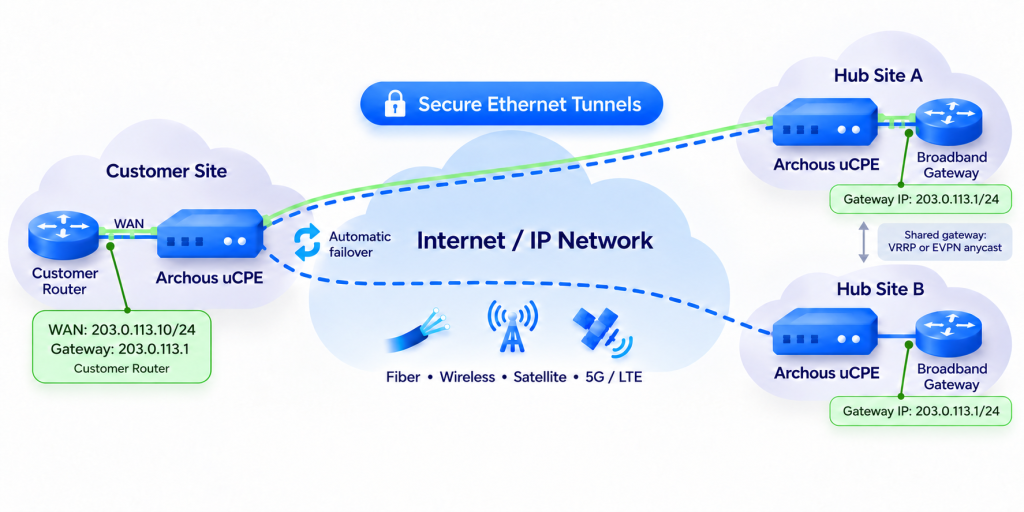
The design consists of four simple building blocks:
Standardized customer equipment.
Each location uses an Archous uCPE device connected to one or more Internet providers. These devices establish secure Ethernet tunnels and can automatically switch between available connections.
Redundant ISP hubs.
Customer traffic terminates at hub locations that connect to broadband gateways or the appropriate Ethernet service handoff. Multiple hubs provide alternative termination points.
Flexible transport.
Fiber, fixed wireless, Starlink, 5G, or LTE can carry the service. Changing an underlying provider does not require redesigning the customer’s Ethernet connectivity.
Secure Ethernet tunnels.
The overlay carries customer Ethernet traffic across the underlying IP network, connecting locations without requiring intermediate equipment to participate in the customer’s Layer 2 service.
For ISP operators, this creates a practical way to introduce Ethernet circuits across an existing network and extend services beyond their own physical footprint using third-party connectivity.
Instead of deploying MPLS throughout the core, operators can introduce the service at customer endpoints and hub locations. The existing network continues transporting IP traffic, while the overlay provides the Ethernet service. Operators can expand incrementally as customer demand grows.
Circuit performance depends on the bandwidth, latency, jitter, and packet loss of the underlying connections. Selecting suitable transport remains important when defining customer service expectations.
Common Failure Scenarios
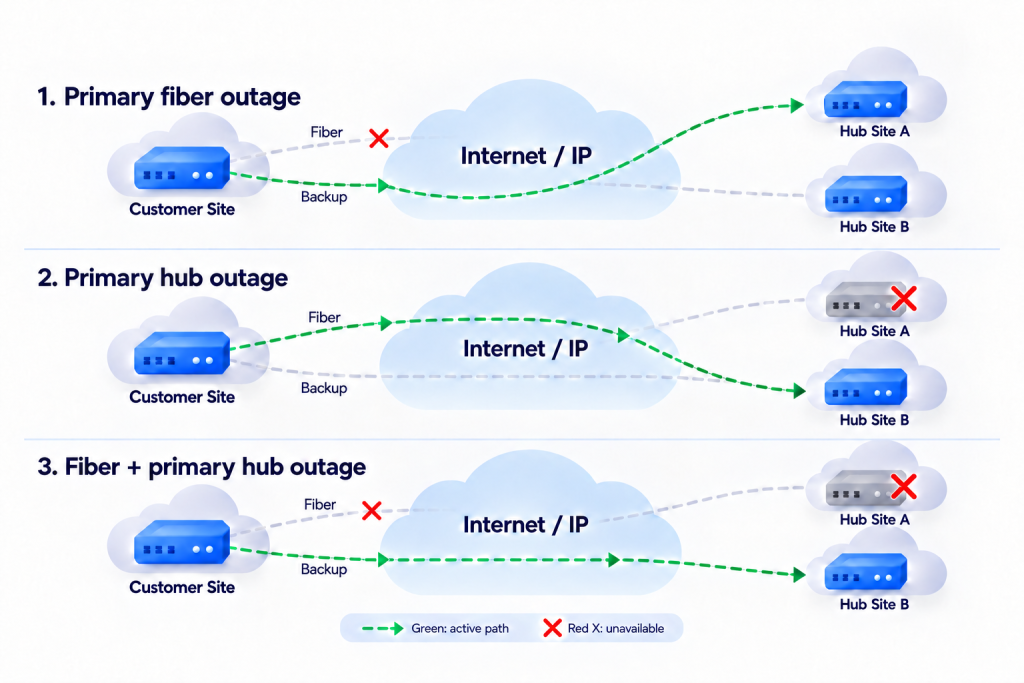
One of the biggest advantages of this design is its ability to recover automatically from failures.
The uCPE monitors the primary connection and can move traffic to a backup path when the primary connection fails or meets configured degradation thresholds. When the primary connection recovers, traffic can return automatically according to the configured policy.
Reliability also extends beyond the customer location. Redundant ISP hub sites provide alternative paths if a data center or aggregation point becomes unavailable. With the necessary service dependencies included in the design, this supports continuity during equipment failures, maintenance events, and larger facility outages.
The architecture is designed to accommodate:
- Loss of the primary fiber connection.
- Failure of an ISP hub or aggregation site.
- Simultaneous loss of the primary connection and primary hub.
In a failure scenario traffic is rerouted through available backup resources. The interruption customers experience depends on failure detection, convergence, and application behavior but usually can be architected to occur within seconds.
Operational Benefits
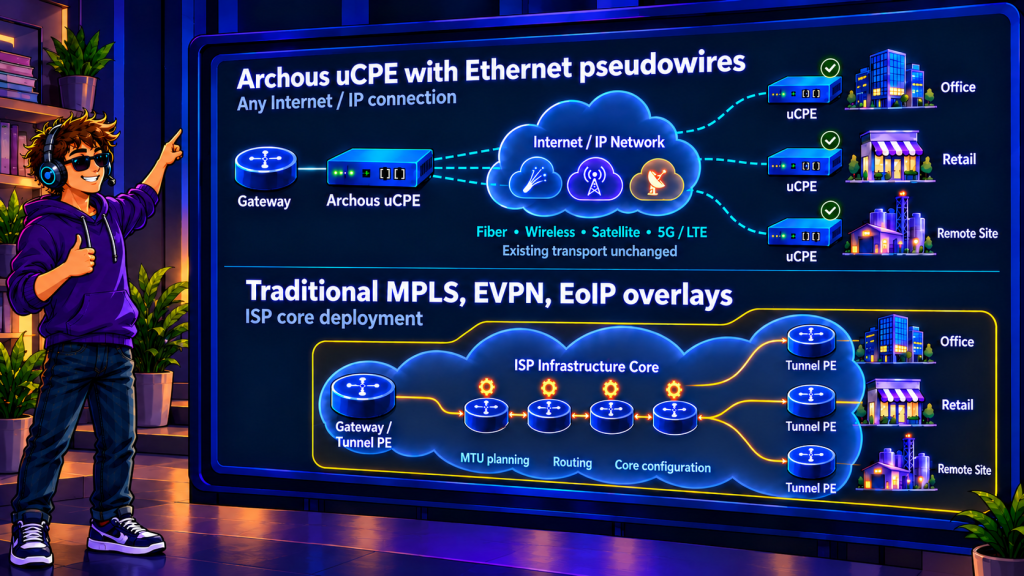
Beyond resilience, the solution simplifies operations. Standardized uCPE hardware that’s only required at tunnel endpoints makes deployments consistent, while centralized management and reusable templates help operators deploy services efficiently.
Because the overlay remains consistent across different transport providers, carrier changes and access upgrades become easier to manage.
This architecture is well suited for:
- ISPs delivering high-performance Ethernet circuits without rebuilding their core.
- Operators extending services across third-party access networks.
- ISPs delivering extended resilient broadband services.
- Enterprise networks connecting multiple locations.
- Retail locations requiring dependable payment-system connectivity.
- Industrial and remote sites with limited fiber availability.
- Organizations seeking an alternative to traditional private WAN services.
By combining standardized customer equipment, redundant hubs, and multiple connectivity options, Archous helps businesses improve service continuity and gives operators a practical path to delivering new Ethernet services over existing infrastructure.
Contact Archous to explore resilient broadband and managed Ethernet services without rebuilding your network core.